Why most AI courses read like a chatbot — and how to fix it
Generic, hedged, weirdly formal. Most AI-generated training has a tell. Here's where it comes from — and the editorial pass that strips it out.

You can usually spot an AI-generated course within the first screen. The tone is oddly formal. Every sentence hedges. It introduces a topic, then re-introduces it, then reminds you why the topic matters — without ever telling you anything you didn't already assume. It's grammatically perfect and completely forgettable.
This isn't a model problem so much as a process problem. When you ask a language model to "write a course on data security," you get exactly what you asked for: a course-shaped object. What you didn't ask for — and won't get — is editing, point of view, or a reason for any of it to exist.

Where the chatbot tone comes from
Three habits show up again and again in raw AI course output. Once you notice them, you can't unsee them:
- The throat-clear. Every section opens by restating the section title as a sentence. "Phishing is an important topic in cybersecurity." We know — it's the heading.
- The hedge. "It is generally considered best practice to often verify…" Strong guidance gets sanded down into mush that commits to nothing.
- The list with no spine. Five bullet points of equal weight, no sense of what matters most or what to do first.
Fast courses are easy. Good ones take an editor — so we built one in.
The fix: an editorial pass, not a bigger prompt
The instinct is to write a more elaborate prompt. That helps a little, then plateaus. What actually moves the needle is treating generation and editing as separate jobs — the way a real publication does.
1. Generate for substance, not polish
The first pass should care about getting the facts, structure and learning objectives right. Tone comes later. Trying to do both at once is what produces fluent nonsense.
2. Edit for a human reader
A dedicated editing pass cuts the throat-clears, removes hedging, and gives each lesson a clear point. This is the step almost everyone skips — and the single biggest difference between a course that feels human and one that feels generated.
3. Pressure-test the learning
Finally: does it actually teach? Are there moments of active recall? Does difficulty build in the right order? A course can read beautifully and still fail the learner — so this pass checks the pedagogy, not the prose.
What this looks like in Saga
Every course Saga generates runs through these stages automatically. A research-and-draft step gets the substance right. An editorial agent rewrites for clarity and voice. A learning-design review checks recall, sequencing and load. You see a finished, edited course — not a first draft with your logo on it.
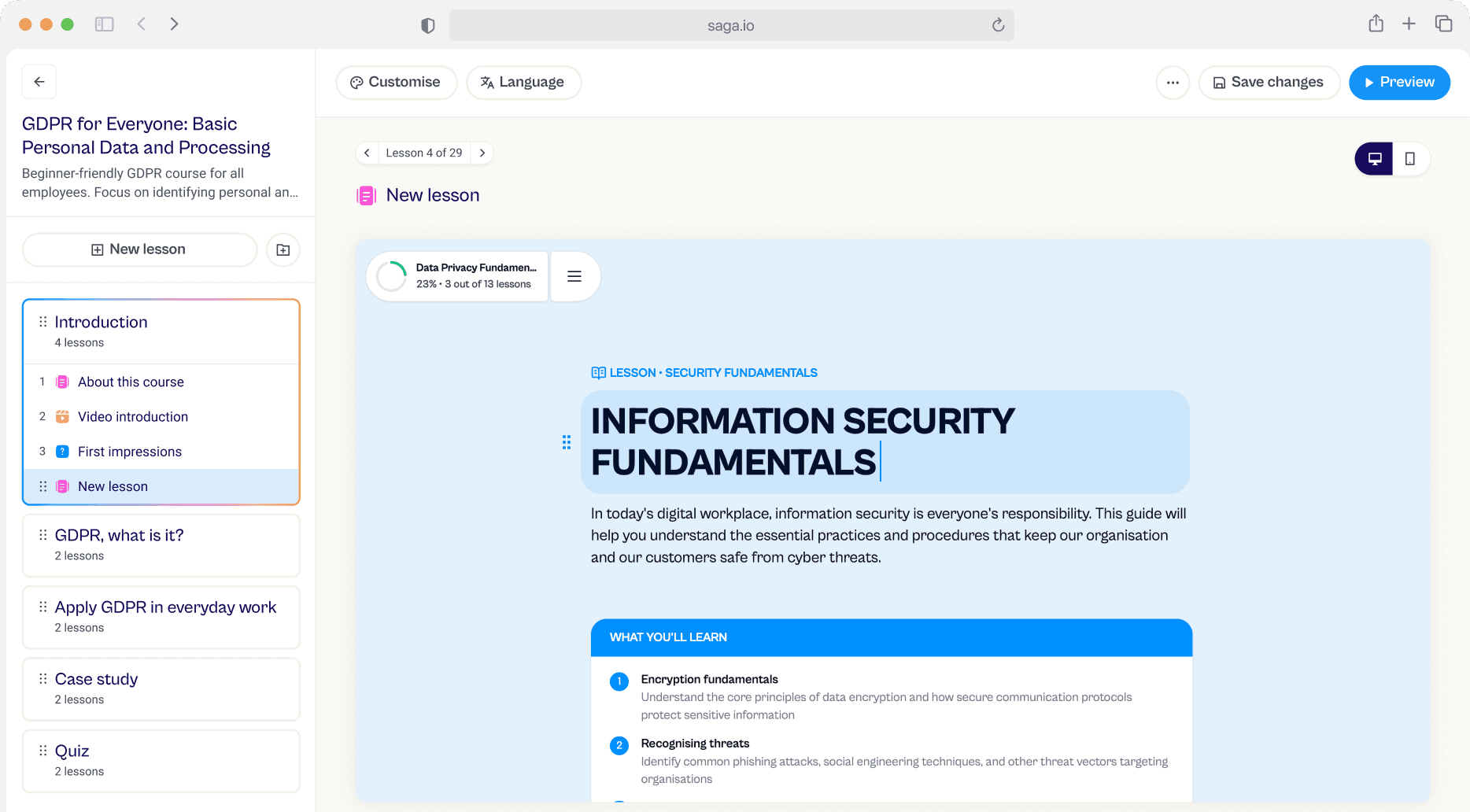
None of this is magic. It's just the boring, essential craft that good publications have always done — encoded so it happens every time, in minutes instead of weeks. That's the whole point: not courses faster, but good courses, fast.
Head of Learning at Saga. Twelve years designing training for European enterprises before deciding software should do the boring parts.
Learning in the Flow of Work: What It Means and Why It Matters
Learn what learning in the flow of work means, why it matters for employee development, and how companies can make workplace learning easier to access, apply and update.
Why Employee Training Goes Out of Date So Fast
Employee training content can become outdated faster than you think. Learn why training materials go out of date and how to keep workplace training accurate, relevant and useful.
The Hidden Cost of Slow Course Creation
Slow course creation costs more than time. Learn how long eLearning development can affect productivity, training quality and knowledge sharing, and how AI can help.
Get the occasional good email.
New writing on AI, learning design and building Saga — roughly twice a month. No spam, unsubscribe anytime.